A Community of Practice

When I thought of doing research this summer, the thought of community was not close to my mind. I pictured myself sitting alone somewhere doing work, not engaging a great deal with other people. When I got settled in this fellowship, I realized how important our community of practice really is. While there are a great many ways in which we still have to take responsibility for our own work, there are always people to catch us when we fall, and encourage us to move forward through our research.

Being thrown into living with the people that I’m working with this summer has taught me a great deal about valuing community. When we’re at the library doing our work, we inevitably come across frustrations in our research. But when we got home for the night, we are able to distress with people who are going through precisely the same thing. When I get excited by an idea, I know to go tell my fellow cohorts to test it out on them and get some feedback. Living and working with the same people creates a system of support that offers empathy in so many circumstances.

Of course, it is so helpful to have the research partners in the library as well. When we are able to interact with people who have been working in the DH field for longer than we have, we are able to hear their knowledge. The task set before me would be a daunting one if I did not have Clint and the rest of the librarians to offer guidance when I started to lose hope. I think in terms of the library, our sharing session on Friday really showcased the value of our community here. I had spoken to a few of my fellow students about feeling drained last week and struggling to stay motivated. A couple of us mentioned this in our session, and all the librarians agreed. Being apart of this community means that we are not alone but instead we are able to share our emotions and our thoughts with people who will support us.

Through our sessions we have met other people at Gettysburg doing DH work. It has been interesting to see their projects and the range. We have Kolbe fellows who are more straight humanities oriented than our cohort, yet they are able to incorporate digital aspects to their projects. Then we have the DTSF’s whose projects are in the technology field. They are not doing humanities per say, but they are a part of of our community because often they come to our sessions to learn beside us. There are also faulty members who participate in our sessions and engage in conversation with us about the nuances of Digital Humanities.

Lastly, we were able to meet the fellows at Bucknell last week. While I wasn’t able to talk to all of them extensively, I was able to talk to a boy named Craig about his project. He was studying the way that the media portrays mental health issues and I thought his project was fascinating. It spurred a conversation amongst my table about this issue in society. I think we were in some ways able to give Craig some ideas that he may explore in his research.

Research seems like a rather individual and lonely practice, but when it is Digital Humanities research, the principles ring true and call for the importance of collaboration and openness throughout the community.

Week Three Reflective Essay

As someone who is much more familiar with the Humanities side of Digital Humanities, I knew that the collaborative nature of this fellowship would be unfamiliar. Luckily, the fellowship is set up to both model and facilitate good practice for working together with peers and mentors alike. Watching the DSSF committee work together throughout the process has set a good example for the way scholarly discussion can flourish in a community. The committee has not only demonstrated how to collaborate, but it has also allowed me (and the other members of the student cohort) to join in discussions about what DH means and what it can do. Our Wednesday discussions about DH as a discipline as well as our planning sessions on Mondays and Fridays provide a unique space where, regardless of experience in the field of DH, all members of the DSSF community can share their ideas. These sessions are particularly important in a college setting where the professor-student relationship is often slanted such that knowledge moves in only one direction – professor to student. It is really refreshing to have a more open discussion where I feel my knowledge is valued and I can also gain from others’ knowledge.

I have also seen collaboration in the public sessions of the DSSF workshops. I have thoroughly enjoyed talking to professors (shout out to Dr. Robertson) about their research plans and feel that, despite the fact that our projects did not overlap, I was part of a collaborative effort of discovering the possibilities of DH. The public sessions have also been available to Kolbe Fellows and DTSFs, so I can see how DH extends beyond those explicitly involved it in—that is, sometimes people who are using DH methods and principles to guide their work would not necessarily describe it as DH.

Our trip to Bucknell this past week allowed me to collaborate with members far from home, while continuing to talk to those closest to my DSSF experience – namely the student cohort. While most of our time was spent learning a new tool, I most enjoyed the time we had to discuss our projects. I was inspired by the big dreams the other students had for their projects and by their model I started thinking about my project in terms of possibility rather than limitation. I was also able to hear their perspective of ways to improve my project with all the possibilities of DH. On the ride back from Bucknell I was able to see how my experience was similar to and different from that of one of the other members of my cohort, thus tying together my discussions with the Bucknell DSSRF cohort and the Gettysburg DSSF.

My cohort has been invaluable to my experience in the DSSF program because hearing about their projects continues to give me new perspectives on my own work. Moreover, I really enjoy learning about the other directions DH can take a project; my work in DH will not conclude with this project, so even things that will not directly benefit this project will be of use to me in the future. I think DH collaboration is at its best when all members come with both insight and willingness to learn (the former being much easier to come confidently with). I am grateful to the members of my cohort, the DSSF committee, and everyone else with whom I have engaged with DH who have exemplified this balance.

Reflection #3

Confession: I have never conducted research before.

Okay, so I have, in the not-so-traditional sense. My research consisted of reading the books my professors told me to read and writing a paper on them or interviewing the person my editor told me to interview and writing an article about them. I have never sat down… in a library… for eight weeks… and conducted research.

I remember telling people about what I was doing this summer and everyone looking at me confused. My dad asked… no… exclaimed... “why would someone pay you to research something you want to research?” I honestly still do not know the answer. But with that obvious boost in my confidence, I was terrified that I would need to prove myself to the DSSF committee every day.

You can imagine my fear subsided when I realized my cohort were all older than me and had already conducted research before, ABSOLUTELY NOT. Now, not only did I have to prove myself to the committee, but I had to prove myself to my cohort.

Introducing myself on the first day, I was so scared that everyone would think my research was pointless or that I totally did not know what I was doing (which is absolutely true). But as days and weeks went by, I realized that everyone was afraid of something. Gus and I bonded over the fear of being unable to articulate what we are actually researching. Maddie and I have laughed over how confusing the ‘digital’ side of DH is. Ivana and I have motivated each other when we felt like we weren’t getting anywhere. We all have laughed when we didn’t know where we were going with our research, now that I think about it.

The cohort has allowed me to vent about what I am worried about but has also provided tremendous support and encouragement. Ivana, Gus, and I went up and listened to the 1971 recording of Jesus Christ Superstar while we sifted through boxes of archives. Those moments of building community have taught me why DH is important. Rather than comparing ourselves and trying to be better than each other, the cohort helps each other. Emma has shared oral histories with me that she found relevant. Gus has told me about random plays. Somehow, those are some of my favorite finds. The links between my research and the other members’ research make this experience richer. It no longer is five individuals working in the same space, but five colleagues working together.

The committee has been amazing in facilitating the community within the fellows, especially in blending us with the DTSFs and the DSSRFs and allowing us to have time to just talk and get to know each other. The great thing about learning in this type of environment, rather than a class, is that community building in such a key feature. We have time set aside to network and bond and communicate. Talking to Craig (shout out to Craig) at the Bucknell lunch about his research allowed us all to discuss a different side of research. His research isn’t all archives and old dusty books, and it brought out this side that made us all excited again.

I am so excited for all the progress we have all already made, and I am even more excited about the progress that we will have made when these eight weeks are up.

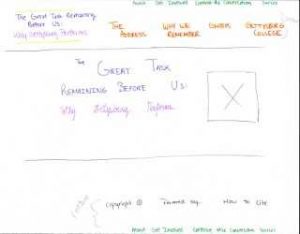
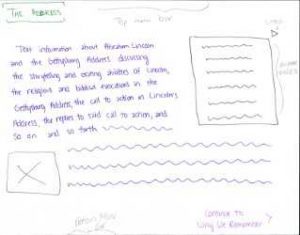
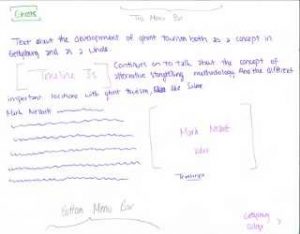
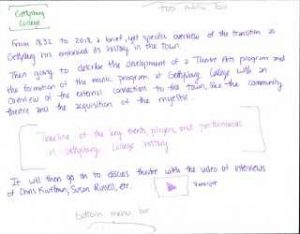
ILE Wireframe

 ILE Wireframe

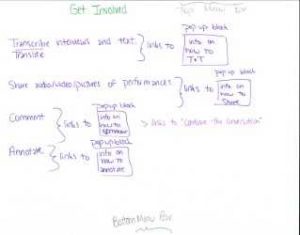
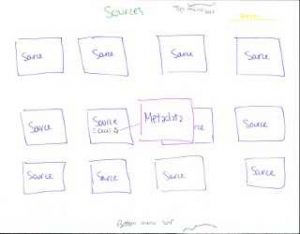
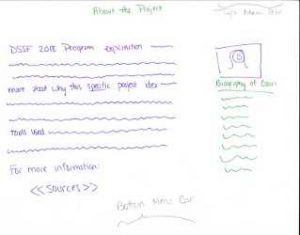
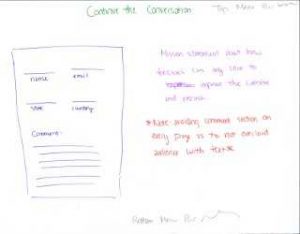
Website pages that are duplicates only have one slide in the power point – this is to illustrate the page layout, not the information. Pages that stand on their own are formatted with questions I need to think about when writing the information. I plan to add a “How to Navigate the Website” paragraph or page that explains the best way to explore the collection of information. I also plan on adding a “Share Your Story” tab for user to contribute to the conversation.

Timeline layout

The timeline layout provides some idea on the formatting of information. (Informal)

Wireframes

My wireframe has been through quite a few drafts this summer. As I develop and refine my project, it is bound to change. I did have one advantage over last summer. This year, I started out knowing exactly what  tool I wanted to use- Scalar.

I work best with physical wireframes, but Scalar can be hard to portray on a two-dimensional space. Scalar allows me to make multiple paths, tags, and other relationships between pages. This wireframe is a rough layout of what my pages will be. Their relationships are in development.

Each Topic post-it indicates a path. Each Person post-it indicates an Oral History I will use. Click on the image for a better quality photo.

This wireframe makes perfect sense in my mind, but that is because I know Scalar and I know how the pages will connect to each other.  For better understanding, I made a PowerPoint that shows an overview of the site and provides links within the document to give a sense of the navigation. I cannot embed it here, but the link allows it to be downloaded for use.

The best way to interact with the wireframe is to open the file and play the presentation. That way, all the links can be accessed and the full scale of the planned site can be seen.

Digital Tool Evaluation: Esri Story Maps

Since I was here last year and already had to do a quick Digital Tool Evaluation, I decided to take a different approach this year. I will talk about a tool I have had to use a lot this past year- Esri Story Maps from ArcGIS.

ArcGIS  Esri Story Maps is a tool that requires payment. At Gettysburg College, we gain access through the school. It is one of the tools used frequently in classes and other projects.  The mapping system can be used to create maps, narratives, and engaging visuals. It is not limited to one style of map or navigational experience. This system can be used to make different styles of maps, from the narrative Cascade to the functional Tour. Cascade focuses on how information is presented and delivered to audiences rather than creating a map. In fact, it can be made without using a conventional map at all. Tour, meanwhile, is a more traditional map tour that provides coordinates, pictures, and some information. Its style is not suited for in depth analysis, however. It serves to function as a map above all.

These maps can be embedded into sites, but it can also function as a site itself. While other mapping systems we use during the fellowship can also be an independent site, Esri story maps look better standing on their own.

The system is fairly easy to use. The interface is navigable for new users and tutorials exist to help master the tool. It takes time to learn everything, but it is not so difficult that it requires outside expertise.The website includes a blog with information about how to make and use story maps in engaging ways.

This tool is used by the school for many projects. While I will not use it for my own work, it has been useful for many other projects, from Killed at Gettysburg to the eventual Named Spaces website. It requires users to supply data, like coordinates and images, but does not require users to build a map from the ground up. Coding knowledge is not needed to make a sleek map. The college does, however, use another facet of ArcGIS to create maps for use in projects, like the Jack Piers Projects trench maps. Maps are supplied for those who cannot or do not want to build their own.

Some features could be improved, however. Inputting coordinates is tricky. I have input coordinates that are used in other mapping systems fine only to be taken to Antarctica while in Esri. The solution, I learned through trial and error, is to put reverse the coordinates. I don’t know why this discrepancy exists, but it can be frustrating. There is another method for inputting coordinates, but it is only specific to three decimal places and is not as accurate as it could be. The markers can also be moved on accident very easily, requiring constant reentering of data or approximating location to set the map back to how it was supposed to look.  

There are some questions supplied by the Criteria for Digital Tool Evaluation that I never thought about beforehand. These questions look into the documentation and data of the tool. I had never critically considered these issues before, as the tool always seemed good and secure. In the past week, I was alerted that the site would transition from HTTP to  the more secure HTTPS in order to increase security of the data. Esri does collect user data, but vows in its privacy statement to “use your personal information only for the benefit of Esri and our affiliates.” The code, meanwhile, is open source and hosted on GitHub for others to see. Esri encourages developer modification and collaboration through its code. As stated before, it does require subscription to use. This paywall limits the amount of people who can use the tool.

All in all, this tool is versatile and effective at what it does. It can be used to create maps and engaging visuals. While there are some tricks to be learned when using it, it is not prohibitively difficult to use. I will continue to work with these story maps to create engaging visuals and narratives.

Reflection #2

One of the most interesting digital tools that we learned last week was StoryMapJS. StoryMapJS is a great digital tool to tell stories that have geographical data associated with them. For me, I liked StoryMapJS better than utilizing ArcGIS because it is more user-friendly, both as a creator and an audience. ArcGIS was very confusing to me, while StoryMapJS just requires easy plug-in for great results.

This digital tool will be able to help me answer the important places that practice performance in Gettysburg, mapped out. This digital tool is free to use, which is great because it follows the ideology of accessibility of digital humanities. StoryMapJS requires location, text, and images. It would be important to make sure whatever media I use is free use. It is very important to me that the tools remain open source.

Some biases that StoryMapJS have made is that every ‘map’ is geographic in its nature. So, even if it is analyzing a painting, it is still reading as a map, technically. While that can be great, sometimes it may not be the best option, as images need to be extremely large in rendering.

I can not see how often the code is updated, so I don’t know if that would mean that something would break and never be able to be fixed.

Some other possible issue with StoryMapJS is that certain data is not great for mapping. While this will work for me because my data is condensed to one area, for data that covers the globe, it would be dizzying and annoying to use. The tool is easy to use and does not require outside expert or special technical skills.

I think that would use StoryMapJS for my project because it would add another layer of depth to my website.

css.php